Behavioral Basics – Biases That Break Judgment#
Security decisions are made by people, and people make predictable errors. Anchoring warps estimates, overconfidence inflates certainty, and framing flips preferences without changing the underlying facts.
The field of behavioral decision science – built on decades of work by Kahneman, Tversky, and others – has identified dozens of cognitive biases. We focus here on the handful that have the largest demonstrated impact on risk estimation and resource allocation in organizational settings. Each bias is paired with at least one practical countermeasure.
Why this matters for security#
Every time an analyst estimates breach likelihood, a SOC triages an alert, or a board member evaluates a risk report, cognitive biases are shaping the outcome. Cognitive biases are systematic patterns that push estimates in consistent directions. Understanding them turns “people are bad at risk” from a vague complaint into a concrete list of failure modes you can test for and mitigate.
The security domain is particularly susceptible because it combines rare events, high stakes, ambiguous feedback, and time pressure – exactly the conditions under which heuristics substitute for analysis. A SOC analyst processing 500 alerts per shift must use shortcuts; the question is whether those shortcuts are calibrated or arbitrary.
Setup#
We use decision-security’s Bayes module for updating beliefs and scoring
predictions, and synth for generating simulated judgment data.
import numpy as np
import matplotlib.pyplot as plt
from scipy import stats

from decision_security.synth import make_rng, sample
from decision_security.bayes import beta_update, brier_score, calibration_curve

rng = make_rng(42)
plt.rcParams.update({
    "font.family": "serif",
    "font.size": 10,
    "axes.labelsize": 11,
    "axes.titlesize": 12,
    "xtick.labelsize": 9,
    "ytick.labelsize": 9,
    "legend.fontsize": 9,
    "figure.dpi": 150,
    "axes.spines.top": False,
    "axes.spines.right": False,
})

PRIMARY = "#1A1A1A"
ACCENT = "#E74C3C"
DARK_BG = "#34495E"
LIGHT_GRAY = "#95A5A6"
MED_GRAY = "#7F8C8D"
VERY_LIGHT = "#BDC3C7"
Anchoring#
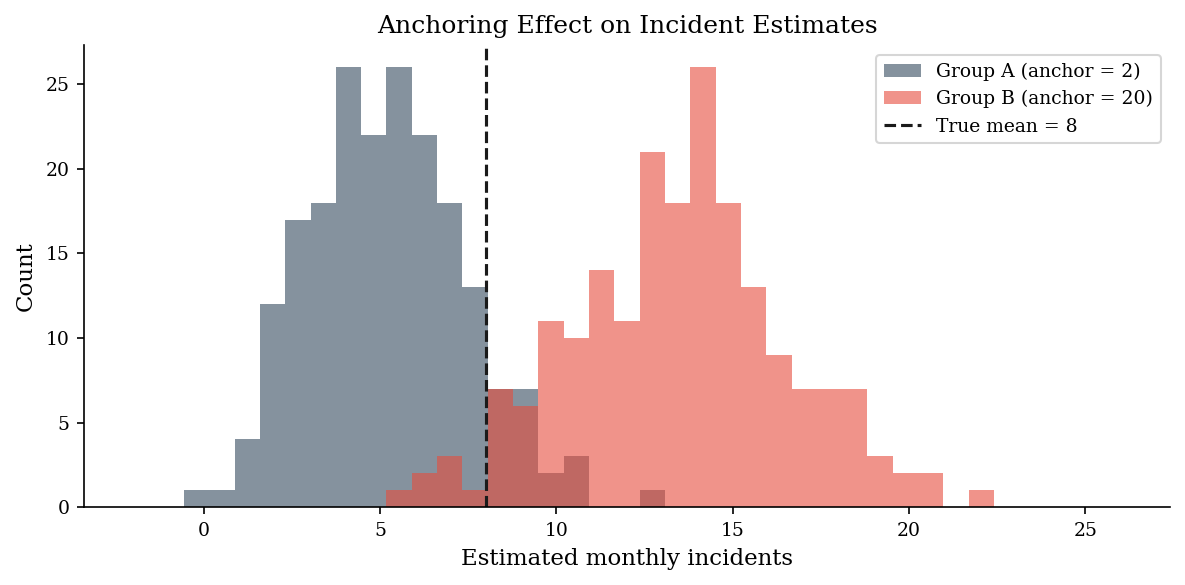
Anchoring occurs when an irrelevant number influences a subsequent estimate. In experiments, spinning a random wheel before asking people to estimate the percentage of African countries in the UN reliably shifts their answers toward the wheel’s number. In security, the anchor is often the last incident’s cost, a vendor’s “average breach” statistic, or whatever number appeared on the previous slide.
The practical effect: if your threat-intelligence vendor opens a briefing with “$4.99M average breach cost” (IBM 2026), every estimate your team produces in that meeting will drift toward that figure – regardless of whether it reflects your organization’s size, your industry, or your control posture.
We simulate two analyst groups – one primed with a low anchor (2 incidents) and one with a high anchor (20 incidents) – and compare the resulting estimates. The true mean is 8 incidents/month.
Tip: In risk workshops, collect initial estimates via anonymous written submission before any data is presented or discussed. This produces unanchored baselines that you can then refine with evidence.
true_mean = 8
n_analysts = 200
alpha = 0.45  # anchoring strength: fraction of the way pulled from truth toward the anchor

low_anchor, high_anchor = 2, 20

group_a = true_mean + alpha * (low_anchor - true_mean) + sample("normal", n_analysts, rng=rng, loc=0.0, scale=2.5)
group_b = true_mean + alpha * (high_anchor - true_mean) + sample("normal", n_analysts, rng=rng, loc=0.0, scale=3.0)

print(f"Anchoring strength alpha = {alpha}")
print(f"Group A (anchor={low_anchor}):  mean estimate = {group_a.mean():.1f}")
print(f"Group B (anchor={high_anchor}): mean estimate = {group_b.mean():.1f}")
print(f"True monthly mean:   {true_mean}")
Anchoring strength alpha = 0.45
Group A (anchor=2):  mean estimate = 5.2
Group B (anchor=20): mean estimate = 13.5
True monthly mean:   8
fig, ax = plt.subplots(figsize=(8, 4))
bins = np.linspace(-2, 26, 40)
ax.hist(group_a, bins=bins, alpha=0.6, label="Group A (anchor = 2)", color=DARK_BG)
ax.hist(group_b, bins=bins, alpha=0.6, label="Group B (anchor = 20)", color=ACCENT)
ax.axvline(true_mean, color=PRIMARY, ls="--", lw=1.5, label=f"True mean = {true_mean}")
ax.set_xlabel("Estimated monthly incidents")
ax.set_ylabel("Count")
ax.set_title("Anchoring Effect on Incident Estimates")
ax.legend()
plt.tight_layout()
plt.show()
Overconfidence and Calibration#
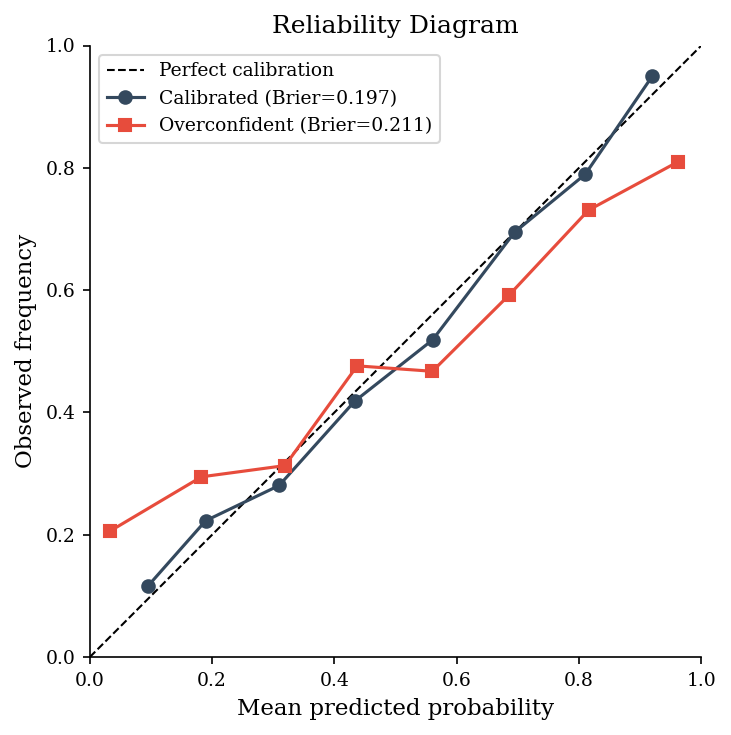
Most people – including domain experts – produce confidence intervals that are far too narrow. When asked for a 90% confidence interval, well-calibrated estimators should contain the true answer 90% of the time. In practice, most people’s “90% intervals” contain the truth only 50-60% of the time.
Calibration is measurable. The Brier score grades probabilistic forecasts:
where \(f_i\) is the forecasted probability and \(o_i\) is the outcome (0 or 1). Lower is better: perfect forecasts score 0, but perfect calibration does not – a calibrated forecaster who says 50% on fair coin flips scores 0.25. A reliability diagram plots predicted probabilities against observed frequencies – a well-calibrated forecaster traces the diagonal.
Every risk-based prioritization depends on probability estimates. If your team consistently rates events at 20% when they occur 40% of the time, your entire risk register is systematically under-weighted, and resource allocation follows suit. Calibration training – giving people feedback on their prediction accuracy – is one of the few interventions with robust evidence of improving judgment.
We simulate 1,000 binary events, generate a calibrated forecaster and an overconfident one, then compare their Brier scores and reliability diagrams.
n_events = 1000

true_probs = rng.uniform(0.1, 0.9, size=n_events)

outcomes = rng.binomial(1, true_probs)

# Calibrated: unbiased, noisy read of the truth
calibrated = np.clip(true_probs + rng.normal(0, 0.05, n_events), 0.01, 0.99)

# Overconfident: the same read, pushed toward the extremes
overconfident = np.clip(0.5 + 1.6 * (calibrated - 0.5), 0.01, 0.99)

bs_cal = brier_score(calibrated, outcomes)
bs_over = brier_score(overconfident, outcomes)

penalty = bs_over - bs_cal
print(f"Brier score (calibrated):     {bs_cal:.4f}")
print(f"Brier score (overconfident):  {bs_over:.4f}")
print(f"Overconfidence penalty:       {penalty:+.4f}")
Brier score (calibrated):     0.1969
Brier score (overconfident):  0.2114
Overconfidence penalty:       +0.0145
bins_k = 8
cen_cal, emp_cal = calibration_curve(calibrated, outcomes, bins=bins_k)
cen_over, emp_over = calibration_curve(overconfident, outcomes, bins=bins_k)

fig, ax = plt.subplots(figsize=(5, 5))
ax.plot([0, 1], [0, 1], "k--", lw=1, label="Perfect calibration")
ax.plot(cen_cal, emp_cal, "o-", color=DARK_BG, label=f"Calibrated (Brier={bs_cal:.3f})")
ax.plot(cen_over, emp_over, "s-", color=ACCENT, label=f"Overconfident (Brier={bs_over:.3f})")
ax.set_xlabel("Mean predicted probability")
ax.set_ylabel("Observed frequency")
ax.set_title("Reliability Diagram")
ax.legend(loc="upper left", fontsize=9)
ax.set_xlim(0, 1)
ax.set_ylim(0, 1)
ax.set_aspect("equal")
plt.tight_layout()
plt.show()
Framing Effects#
Prospect theory shows that people weight losses roughly twice as heavily as equivalent gains. This is called loss aversion, and it interacts with framing to produce inconsistent decisions. Telling a board “this control saves $3M in expected losses” produces a different reaction than “without this control, we face $3M in expected losses” – even though the information is identical.
Loss framing can help secure funding for important controls, and it can also create panic-driven overspending. The best approach is to present both frames side by side and let the numbers, without the emotional frame, drive the decision.
A related trap is reference-point dependence. Whether a 15% reduction in incident frequency feels like progress or failure depends entirely on what stakeholders expected. If the target was 20%, it feels like failure; if no target was set, it feels like success. Setting explicit, quantified baselines before measuring outcomes prevents this kind of post-hoc reframing.
Quantifying loss aversion#
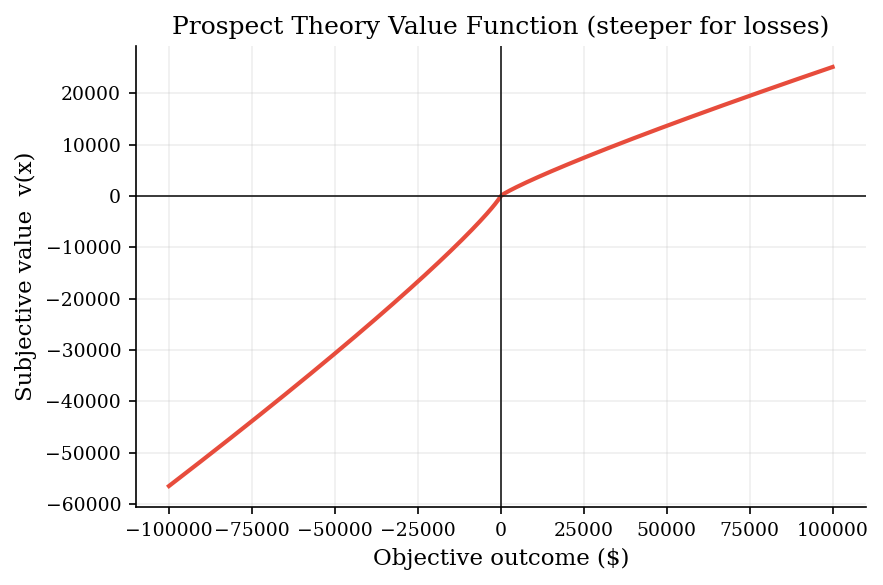
Prospect theory gives loss aversion a concrete functional form. The value function is concave for gains, convex for losses, and markedly steeper on the loss side. Tversky and Kahneman’s 1992 fit uses a curvature exponent of 0.88 and a loss-aversion multiplier of 2.25 – so the pain of a loss is about 2.25x the pleasure of the equivalent gain. Plotting it shows exactly why “we might lose $100K” mobilizes a board that “we might save $100K” leaves cold.
# Prospect theory value function (Tversky & Kahneman 1992 parameters)
#   v(x) =  x**0.88              for gains  (x >= 0)
#   v(x) = -2.25 * (-x)**0.88    for losses (x < 0)
alpha_pt, lam = 0.88, 2.25

def pt_value(x):
    x = np.asarray(x, dtype=float)
    # split the sign so we never raise a negative base to a fractional power
    gains = np.where(x >= 0, x, 0.0)
    losses = np.where(x < 0, -x, 0.0)
    return np.where(x >= 0, gains ** alpha_pt, -lam * losses ** alpha_pt)

mag = 100_000
print(f"Subjective value of a ${mag:,.0f} gain: {pt_value(mag):+,.0f}")
print(f"Subjective value of a ${mag:,.0f} loss: {pt_value(-mag):+,.0f}")
print(f"Loss / gain: {abs(pt_value(-mag) / pt_value(mag)):.2f}x")

xs = np.linspace(-mag, mag, 400)
fig, ax = plt.subplots(figsize=(6, 4))
ax.plot(xs, pt_value(xs), color=ACCENT, lw=2)
ax.axhline(0, color=PRIMARY, lw=0.8)
ax.axvline(0, color=PRIMARY, lw=0.8)
ax.set_xlabel("Objective outcome ($)")
ax.set_ylabel("Subjective value  v(x)")
ax.set_title("Prospect Theory Value Function (steeper for losses)")
ax.grid(alpha=0.2)
plt.tight_layout()
plt.show()
Subjective value of a $100,000 gain: +25,119
Subjective value of a $100,000 loss: -56,517
Loss / gain: 2.25x
Framing a security metric#
“We blocked 97% of phishing emails” and “3% of phishing emails reached employees” describe the same metric. But the first sounds like success and the second sounds like failure.
If your organization receives 10,000 phishing emails per month, that 3% means 300 malicious emails landing in inboxes. We simulate the number of clicks from those 300 delivered emails to show the operational reality behind the framing.
phishing_volume = 10_000       # total phishing emails/month
filter_rate = 0.97
delivered = int(phishing_volume * (1 - filter_rate))
click_rate = 0.12              # illustrative; phishing-simulation studies report roughly 3-30%

n_months = 1000
clicks_per_month = sample("binomial", n_months, rng=rng, n=delivered, p=click_rate)

print(f"Framing A: 'We blocked {filter_rate:.0%} of phishing.'")
print(f"Framing B: '{delivered} phishing emails reached employees each month.'")
print()
print(f"Simulated clicks/month over {n_months} months:")
print(f"  Mean:   {clicks_per_month.mean():.1f}")
print(f"  Median: {np.median(clicks_per_month):.0f}")
print(f"  P95:    {np.percentile(clicks_per_month, 95):.0f}")
print(f"  Max:    {clicks_per_month.max()}")
Framing A: 'We blocked 97% of phishing.'
Framing B: '300 phishing emails reached employees each month.'

Simulated clicks/month over 1000 months:
  Mean:   35.8
  Median: 36
  P95:    45
  Max:    55
fig, ax = plt.subplots(figsize=(8, 4))
ax.hist(clicks_per_month, bins=range(int(clicks_per_month.min()), int(clicks_per_month.max()) + 2),
        color=DARK_BG, alpha=0.7, edgecolor="white")
ax.axvline(np.percentile(clicks_per_month, 95), color=ACCENT, ls="--",
           label=f"95th percentile = {np.percentile(clicks_per_month, 95):.0f}")
ax.set_xlabel("Employee clicks on phishing emails per month")
ax.set_ylabel("Frequency")
ax.set_title('Behind "97% Blocked": Monthly Phishing Clicks')
ax.legend()
plt.tight_layout()
plt.show()

p95_clicks = np.percentile(clicks_per_month, 95)
print(f"Both framings, same outcome: about {clicks_per_month.mean():.0f} clicks a month, "
      f"{p95_clicks:.0f} in a bad month (P95).")
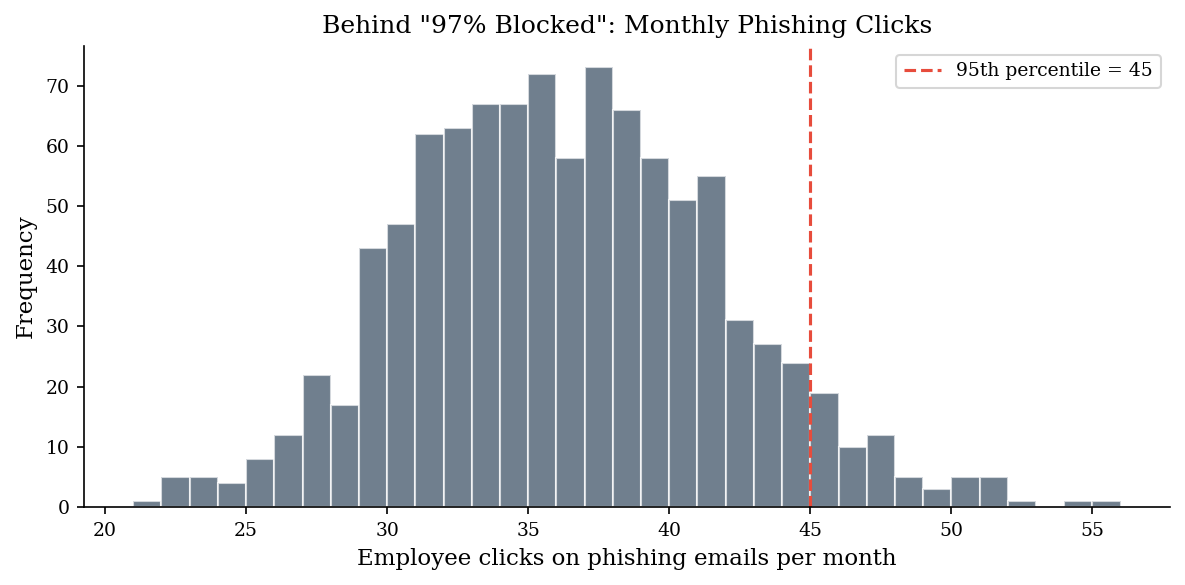
Both framings, same outcome: about 36 clicks a month, 45 in a bad month (P95).
What changes is the reference point. “97% blocked” measures from all phishing sent, so the result reads as a gain, and people protect gains: nothing looks broken. “300 reached employees” measures from an empty inbox, so the same number reads as a loss, and a number labelled as a failure is judged more harshly than the same number labelled as a success (attribute framing; Levin & Gaeth 1988). That frame creates urgency and makes costly fixes easier to approve.
Neither frame is wrong, but each one steers the decision. A more neutral report gives the operational numbers – clicks per month and the bad-month figure – so readers react to the outcome, not the wording.
Bayesian Update – Structured Reasoning as Bias Antidote#
Bayesian updating provides a mechanical antidote to several biases at once. The process is simple: start with a prior belief (your estimate before new evidence), observe evidence (a pentest result, an incident report, a new threat-intel feed), compute the likelihood of that evidence under different hypotheses, and derive a posterior belief.
Writing this down forces you to separate what you knew before from what the evidence actually tells you. It makes the prior’s weight explicit, prevents overweighting dramatic evidence, and creates an auditable trail of reasoning. Even rough estimates plugged into Bayes’ rule produce better-calibrated updates than unaided intuition.
Patch Compliance Example#
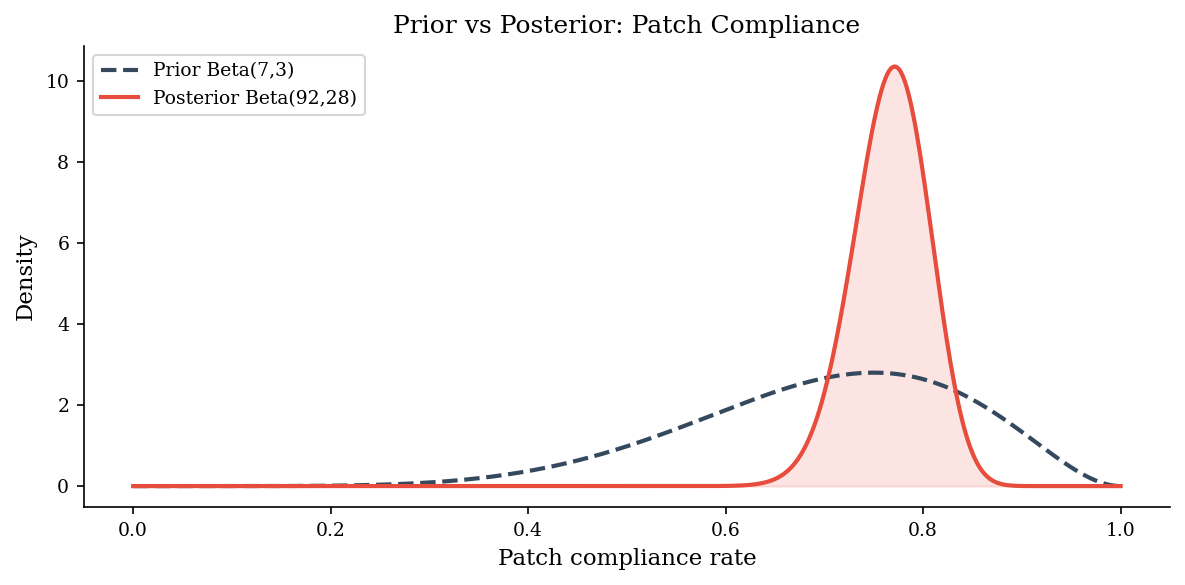
Before collecting data, our prior belief about the patch compliance rate is \(\text{Beta}(7, 3)\) – we think compliance is probably around 70% but we are not very certain.
We then observe 85 patched systems out of 110 checked (25 unpatched). Rather than replacing the prior with the sample proportion (base-rate neglect) or ignoring the data (anchoring on the prior), the Bayesian update combines both – weighting each by its count (the prior acts as 7 + 3 = 10 pseudo-observations, the data as 110). The posterior will land between the prior mean and the data proportion, closer to whichever estimate is backed by more data.
a_prior, b_prior = 7, 3
successes, failures = 85, 25

a_post, b_post = beta_update(a_prior, b_prior, successes, failures)

prior_mean = a_prior / (a_prior + b_prior)
post_mean = a_post / (a_post + b_post)
ci_lo, ci_hi = stats.beta.ppf([0.05, 0.95], a_post, b_post)

print(f"Prior:     Beta({a_prior}, {b_prior})  ->  mean = {prior_mean:.3f}")
print(f"Data:      {successes}/{successes + failures} patched")
print(f"Posterior: Beta({a_post:.0f}, {b_post:.0f})  ->  mean = {post_mean:.3f}")
print(f"Posterior 90% credible interval: [{ci_lo:.3f}, {ci_hi:.3f}]")
Prior:     Beta(7, 3)  ->  mean = 0.700
Data:      85/110 patched
Posterior: Beta(92, 28)  ->  mean = 0.767
Posterior 90% credible interval: [0.701, 0.827]
x = np.linspace(0, 1, 500)
prior_pdf = stats.beta.pdf(x, a_prior, b_prior)
post_pdf = stats.beta.pdf(x, a_post, b_post)

fig, ax = plt.subplots(figsize=(8, 4))
ax.plot(x, prior_pdf, "--", color=DARK_BG, lw=2, label=f"Prior Beta({a_prior},{b_prior})")
ax.plot(x, post_pdf, "-", color=ACCENT, lw=2, label=f"Posterior Beta({a_post:.0f},{b_post:.0f})")
ax.fill_between(x, post_pdf, alpha=0.15, color=ACCENT)
ax.set_xlabel("Patch compliance rate")
ax.set_ylabel("Density")
ax.set_title("Prior vs Posterior: Patch Compliance")
ax.legend()
plt.tight_layout()
plt.show()
Premortem: Debiasing Through Prospective Hindsight#
A premortem inverts the usual project review. Instead of asking “what could go wrong?” (which leaves room for optimism bias), you state: “It is six months from now, and this initiative has failed. Why?” Research by Mitchell, Russo and Pennington (1989), cited by Gary Klein (2007), shows that this prospective-hindsight framing increases the ability to correctly identify reasons for outcomes by roughly 30%.
For security programs, premortems are especially valuable before major control deployments, architecture changes, or policy rollouts. The technique is fast (15-30 minutes in a group setting) and requires no special tools.
The premortem is also a useful political tool. Framing criticism as a hypothetical failure scenario removes the interpersonal risk of disagreeing with a senior leader’s preferred approach.
Scenario: AI Triage Agent in the SOC#
Prompt: It is six months from now. The AI agent that triages alerts has been switched off. The SOC is back to manual triage. What went wrong?
Typical premortem outputs:
Unmeasured accuracy – Nobody audited the alerts the agent closed as benign; a missed intrusion surfaced four months later.
Prompt injection – Attacker-controlled fields (email subjects, file names, user agents) carried instructions that steered the agent to close alerts.
Automation bias – Analysts approved the agent’s verdicts without reading them; junior analysts never learned to triage on their own.
Non-reproducible decisions – The same alert got different verdicts on different runs; auditors could not trace why a case was closed.
Data protection – Logs containing personal data were sent to a hosted model; legal halted the rollout until a review was done.
Each of these is a testable risk that can be monitored and mitigated before the project starts – but they rarely surface in a standard risk register because optimism bias suppresses them.
The Allais Paradox: When Rational Preferences Break#
The Allais paradox (1953), extensively discussed by Raiffa (1968), demonstrates that most people’s risk preferences violate the axioms of expected utility – and that showing them the violation often changes their answer. This is the difference between descriptive and prescriptive decision theory: descriptive theory documents how people actually choose (often inconsistently); prescriptive theory provides a framework for choosing consistently.
Recast as a security investment decision:
Problem 1: Choose between:
A1: Guaranteed
$1Mcompliance outcome (certainty)A2: 10% chance of
$5Mtransformation, 89% chance of$1Mcompliance, 1% chance of$0
Problem 2: Choose between:
A3: 10% chance of
$5Mtransformation, 90% chance of$0A4: 11% chance of
$1Mcompliance, 89% chance of$0
Most people choose A1 over A2 (preferring certainty) and A3 over A4 (preferring the bigger upside). But this pair of choices violates expected utility theory – you cannot consistently hold both preferences under any utility function.
Raiffa’s insight: once the inconsistency is pointed out, many people (Raiffa included) revise their preferences, though experiments show many do not (Slovic & Tversky 1974).
The practical takeaway is not that people should be forced to follow utility theory robotically. It is that when a decision-maker registers inconsistent preferences across two similar choices, the inconsistency should be surfaced and resolved before investment decisions are made – not discovered after the budget is committed.
# Allais paradox under one utility function. Concavity means u5 < 5 * u1.
u1 = 1.0    # utility of the $1M compliance outcome
u5 = 1.7    # utility of the $5M transformation outcome
u0 = 0.0    # utility of $0

# Problem 1
eu_a1 = u1
eu_a2 = 0.10 * u5 + 0.89 * u1 + 0.01 * u0
# Problem 2
eu_a3 = 0.10 * u5 + 0.90 * u0
eu_a4 = 0.11 * u1 + 0.89 * u0

print("=== Allais Paradox: EU consistency check ===")
print(f"Stated utilities: u($1M)={u1}, u($5M)={u5}, u($0)={u0}")
print()
print(f"Problem 1:  EU(A1)={eu_a1:.3f}  vs  EU(A2)={eu_a2:.3f}  ->  EU picks {'A1' if eu_a1 > eu_a2 else 'A2'}")
print(f"Problem 2:  EU(A3)={eu_a3:.3f}  vs  EU(A4)={eu_a4:.3f}  ->  EU picks {'A3' if eu_a3 > eu_a4 else 'A4'}")
print()
print("A1>A2 requires 0.11*u1 > 0.10*u5 + 0.01*u0;  A3>A4 requires the reverse.")
print(f"  0.11*u1 = {0.11 * u1:.3f}   vs   0.10*u5 + 0.01*u0 = {0.10 * u5 + 0.01 * u0:.3f}")
print()
print("One utility function cannot produce both common choices (A1 and A3).")
=== Allais Paradox: EU consistency check ===
Stated utilities: u($1M)=1.0, u($5M)=1.7, u($0)=0.0

Problem 1:  EU(A1)=1.000  vs  EU(A2)=1.060  ->  EU picks A2
Problem 2:  EU(A3)=0.170  vs  EU(A4)=0.110  ->  EU picks A3

A1>A2 requires 0.11*u1 > 0.10*u5 + 0.01*u0;  A3>A4 requires the reverse.
  0.11*u1 = 0.110   vs   0.10*u5 + 0.01*u0 = 0.170

One utility function cannot produce both common choices (A1 and A3).
Intransitive Preferences: The Money Pump#
Intransitivity means each pairwise comparison is won by a different alternative: A beats B, B beats C, but C beats A. This cycle arises naturally when different criteria dominate different comparisons.
In security, this manifests when control comparisons use shifting criteria. Each pairwise judgment feels reasonable, but the cycle means the ranking is exploitable – the decision-maker is a “money pump” (Davidson, McKinsey & Suppes 1955) from whom value can be extracted through sequential trades around the cycle.
Security version: A CISO ranks three controls:
EDR > WAF because EDR has better threat coverage and lower FP rate
WAF > SIEM because WAF is cheaper and faster to deploy
SIEM > EDR because SIEM provides compliance evidence and broader visibility
The resolution is not to suppress multi-criteria evaluation but to make it explicit and consistent. MCDA (Chapter 0.6) forces the decision-maker to fix criteria weights before comparing alternatives, which eliminates the implicit weight-switching that produces cycles. The discomfort of fixing weights is the point because it surfaces the trade-offs that intransitive preferences keep hidden.
controls = ["EDR", "WAF", "SIEM"]
criteria = ["Threat Coverage", "Cost", "Compliance"]

# Scores (0-10)
scores = {
    "EDR":  [9, 5, 4],
    "WAF":  [6, 8, 5],
    "SIEM": [5, 3, 9],
}

# Each comparison silently uses a different weighting
comparisons = [
    ("EDR", "WAF",  [0.5, 0.3, 0.2]),  # threat-focused
    ("WAF", "SIEM", [0.2, 0.5, 0.3]),  # cost-focused
    ("SIEM", "EDR", [0.2, 0.3, 0.5]),  # compliance-focused
]

print("=== Intransitive Rankings (shifting criteria weights) ===\n")
winners = []
for a, b, weights in comparisons:
    score_a = sum(s * w for s, w in zip(scores[a], weights))
    score_b = sum(s * w for s, w in zip(scores[b], weights))
    winner = a if score_a > score_b else b
    winners.append(winner)
    print(f"  {a} vs {b} (weights: {dict(zip(criteria, weights))})")
    print(f"    {a}: {score_a:.1f}  vs  {b}: {score_b:.1f}  -> {winner} wins")
    print()

# The comparisons chain A-B, B-C, C-A: a cycle means every first (or every second) option won.
chain = [a for a, _, _ in comparisons]
if all(w == a for (a, _, _), w in zip(comparisons, winners)):
    print("Cycle: " + " > ".join(chain + chain[:1]) + "\n")
elif all(w == b for (_, b, _), w in zip(comparisons, winners)):
    print("Cycle: " + " > ".join(chain[::-1] + chain[-1:]) + "\n")
else:
    print("No cycle with these weights\n")

w_fixed = [0.5, 0.3, 0.2]
totals = {c: sum(s * wi for s, wi in zip(scores[c], w_fixed)) for c in controls}
ranking = sorted(controls, key=lambda c: totals[c], reverse=True)
print(f"Fix one weight vector {dict(zip(criteria, w_fixed))} for ALL comparisons:")
print("  " + " > ".join(f"{c} ({totals[c]:.1f})" for c in ranking))
=== Intransitive Rankings (shifting criteria weights) ===

  EDR vs WAF (weights: {'Threat Coverage': 0.5, 'Cost': 0.3, 'Compliance': 0.2})
    EDR: 6.8  vs  WAF: 6.4  -> EDR wins

  WAF vs SIEM (weights: {'Threat Coverage': 0.2, 'Cost': 0.5, 'Compliance': 0.3})
    WAF: 6.7  vs  SIEM: 5.2  -> WAF wins

  SIEM vs EDR (weights: {'Threat Coverage': 0.2, 'Cost': 0.3, 'Compliance': 0.5})
    SIEM: 6.4  vs  EDR: 5.3  -> SIEM wins

Cycle: EDR > WAF > SIEM > EDR

Fix one weight vector {'Threat Coverage': 0.5, 'Cost': 0.3, 'Compliance': 0.2} for ALL comparisons:
  EDR (6.8) > WAF (6.4) > SIEM (5.2)
Practical Guardrails#
You cannot eliminate bias, but you can build processes that reduce its impact. Six rules that fit on an index card:
Prior, evidence, posterior. Write down your belief before you look at the data. Update explicitly. If you skip this step, anchoring and confirmation bias fill the gap.
Intervals, not points. Every estimate should come with a confidence interval. “We estimate 5-15% annual probability, 80% confidence” is more honest and more useful than “about 10%.” This makes overconfidence visible.
Consider the opposite. Before finalizing any risk assessment, explicitly ask: “What evidence would make us believe the opposite conclusion?” If you cannot articulate any, the assessment is likely anchored, not reasoned.
Separate elicitation from discussion. Collect estimates independently before group discussion to prevent anchoring and groupthink. Aggregate afterward.
Premortem before big bets. Spend 15 minutes assuming failure and listing reasons before committing to a major control investment or architecture change. Cheap insurance against optimism bias.
Brier-score your team. 20-30 binary forecasts per quarter are too few to detect miscalibration reliably; pool several quarters before you judge or coach individuals. Keep a log of probabilistic forecasts and check them against outcomes quarterly. You cannot improve calibration without a feedback loop.
Note: These guardrails are the minimum viable process for treating risk estimates as testable predictions.
What Good Looks Like#
A mature security organization does not eliminate bias. Instead, it builds processes that contain bias and make it detectable:
Risk estimates carry explicit confidence intervals.
Forecasts are logged and scored.
Major decisions include a premortem.
Briefings present both gain and loss frames.
When new evidence arrives, the update follows a structured Bayesian template rather than “let me revise my gut feeling.”
Even partial adoption – say, logging every forecast and reviewing calibration once enough have resolved – builds the feedback loop that calibration needs. The key is consistency: a lightweight process followed every time beats an elaborate process used sporadically.
Tip: Use the Brier scoring and reliability diagram code above as a starter template for a prediction log with automated scoring. Track your team’s forecasts for one quarter and review the calibration curve.