Bayesian Thinking for Threat Intelligence#
Threat intelligence is inherently Bayesian: you start with a belief about threat likelihood, observe indicators, and update. Most security teams do this intuitively — they anchor on vivid threats, ignore base rates, and overweight the latest advisory. This notebook makes the update process explicit and quantitative.
Prerequisites: Part 0 covered Bayesian foundations including Raiffa’s tree-flipping for IDS alerts and beta-binomial updating for patch compliance. Here we go deeper: sequential multi-source updating, likelihood ratios, odds-form reasoning, and forecast calibration.
import numpy as np
import pandas as pd
import matplotlib.pyplot as plt
from scipy import stats

from decision_security.synth import make_rng, sample
from decision_security.bayes import (
    beta_update, brier_score, calibration_curve,
    normal_update_known_variance, logit, inv_logit
)

rng = make_rng(42)

plt.rcParams.update({
    "font.family": "serif",
    "font.size": 10,
    "axes.labelsize": 11,
    "axes.titlesize": 12,
    "xtick.labelsize": 9,
    "ytick.labelsize": 9,
    "legend.fontsize": 9,
    "figure.dpi": 150,
    "axes.spines.top": False,
    "axes.spines.right": False,
})

PRIMARY = "#1A1A1A"
ACCENT = "#E74C3C"
DARK_BG = "#34495E"
LIGHT_GRAY = "#95A5A6"
MED_GRAY = "#7F8C8D"
VERY_LIGHT = "#BDC3C7"
1. Prior Elicitation — What Do You Believe Before the Evidence?#
Every Bayesian analysis starts with a prior. In security, the prior is your belief about threat probability before you see any specific intelligence. The prior should reflect industry base rates, historical data, organizational context — not the specific alert you’re about to analyze.
Three common starting points:
Prior |
When to use |
|---|---|
Uninformative Beta(1,1) |
No historical data at all; every probability equally plausible |
Mildly informed Beta(2,20) |
Sector averages suggest ~10% chance; modest confidence |
Strong Beta(1,99) |
Extensive data shows ~1% base rate; high confidence |
x = np.linspace(0, 0.5, 500)
priors = [
    ("Uninformative Beta(1,1)", 1, 1),
    ("Mildly informed Beta(2,20)", 2, 20),
    ("Strong prior Beta(1,99)", 1, 99),
]

fig, ax = plt.subplots(figsize=(8, 4))
colors_prior = [LIGHT_GRAY, DARK_BG, ACCENT]
for (label, a, b), color in zip(priors, colors_prior):
    pdf = stats.beta.pdf(x, a, b)
    mean = a / (a + b)
    ax.plot(x, pdf, linewidth=2, color=color,
            label=f"{label}, mean={mean:.2f}")

ax.set_xlabel("P(targeted by APT this quarter)")
ax.set_ylabel("Density")
ax.set_title("Prior Beliefs: How Confident Are You Before Seeing Evidence?")
ax.legend()
plt.tight_layout()
plt.show()
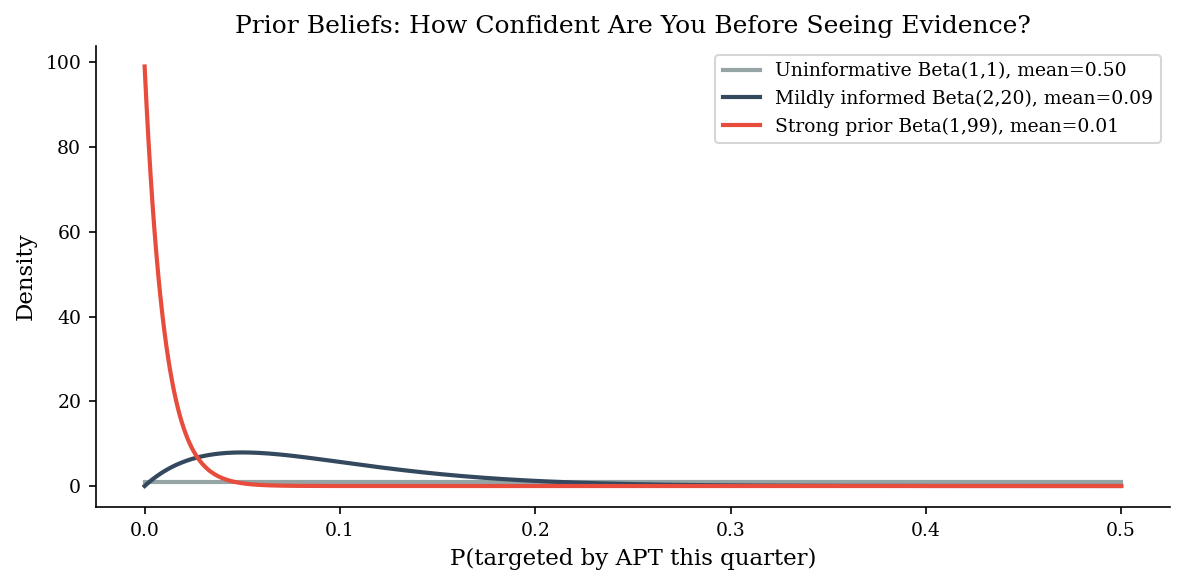
The uninformative prior says “I have no idea”. This is rarely the case in security; you almost always know something. The mildly informed prior centers around 10% but is wide enough to move easily with new evidence. The strong prior is concentrated near 1%.
Key insight: the strength of a prior is determined by its effective sample size (a + b for a Beta distribution). Beta(1,1) has sample size 2 — trivially overridden. Beta(1,99) has sample size 100 — you need dozens of observations to move it.
2. Sequential Updating with Multiple Sources#
Real threat intel comes in waves. A vendor advisory arrives, then a sector-specific ISAC alert, then your own SIEM correlation. Each source has a different sample size (and reliability, which this simple update ignores). Bayesian updating lets you combine them sequentially — each posterior becomes the next prior.
Scenario: We are tracking how widely a specific vulnerability (a recent RCE in an edge device) is being exploited in the wild: θ, the fraction of exposed organizations that get exploited.
Prior: Beta(2, 18) — we think roughly 10% of exposed organizations get exploited, based on historical rates for similar vulnerabilities.
Source 1 (vendor advisory): reports 3 exploited organizations out of 20 monitored.
Source 2 (ISAC report): reports 5 exploited organizations out of 15 peers.
Source 3 (internal SIEM): 0 exploit attempts detected across 100 monitored endpoints in our own network.
a, b = 2, 18
updates = [
    ("Prior: Beta(2,18)", a, b),
]

sources = [
    ("+ Vendor advisory (3/20 exploited)", 3, 17),
    ("+ ISAC report (5/15 exploited)", 5, 10),
    ("+ Internal SIEM (0/100 detected)", 0, 100),
]

for name, s, f in sources:
    a, b = beta_update(a, b, s, f)
    updates.append((name, a, b))

fig, ax = plt.subplots(figsize=(9, 4))
x = np.linspace(0, 0.5, 500)
colors_seq = [VERY_LIGHT, LIGHT_GRAY, DARK_BG, ACCENT]

for (label, a_val, b_val), color in zip(updates, colors_seq):
    pdf = stats.beta.pdf(x, a_val, b_val)
    mean = a_val / (a_val + b_val)
    ax.plot(x, pdf, linewidth=2, color=color,
            label=f"{label}: mean={mean:.3f}")

fa, fb = updates[-1][1], updates[-1][2]
mean_x = fa / (fa + fb)
ax.annotate("Internal SIEM (0/100) dominates:\n100 local non-detections pull the belief back down",
            xy=(mean_x, stats.beta.pdf(mean_x, fa, fb)),
            xytext=(0.20, stats.beta.pdf(mean_x, fa, fb) * 0.65),
            fontsize=8, color=ACCENT,
            arrowprops=dict(arrowstyle="->", color=ACCENT, lw=0.8))

ax.set_xlabel("θ = fraction of exposed organizations exploited")
ax.set_ylabel("Density")
ax.set_title("Sequential Bayesian Updating: Each Source Shifts the Belief")
ax.legend(fontsize=8)
plt.tight_layout()
plt.show()

for label, a_val, b_val in updates:
    print(f"{label:38s} mean θ = {a_val / (a_val + b_val):.1%}")
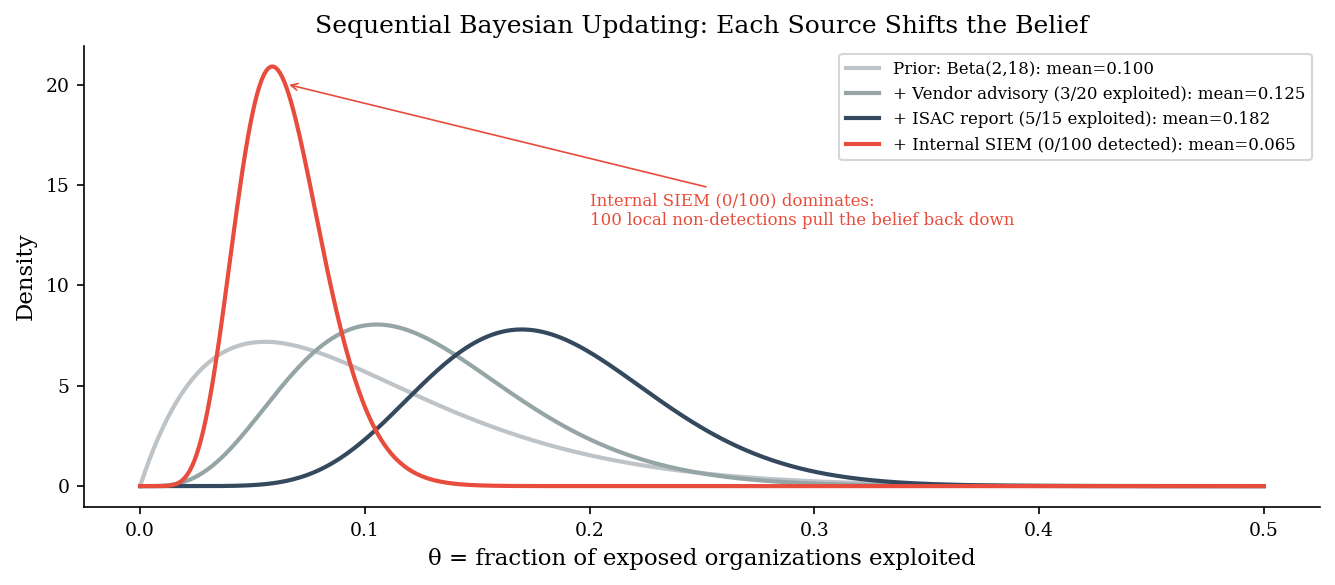
Prior: Beta(2,18)                      mean θ = 10.0%
+ Vendor advisory (3/20 exploited)     mean θ = 12.5%
+ ISAC report (5/15 exploited)         mean θ = 18.2%
+ Internal SIEM (0/100 detected)       mean θ = 6.5%
Notice two things:
The posterior gets narrower with each update here. More data means more certainty on average; a single surprising observation can widen it.
The internal SIEM (0/100) dominates. It contributes 100 observations — more than the vendor and ISAC combined. Large, local datasets outweigh small, external ones. But the 100 endpoints sit in one network, not 100 independent organizations, and a non-detection is not a non-exploitation, so counting them as 100 failures overstates the SIEM’s weight.
beta_updatealso ignores each source’s reliability.
3. Likelihood Ratios — How Strong Is the Evidence?#
A likelihood ratio (LR) quantifies how much a piece of evidence should shift your belief:
Following the convention from diagnostic testing, the usual rule-of-thumb bands for evidence for the hypothesis (LR > 1) are:
LR > 10: strong evidence for the hypothesis
LR 5–10: moderate evidence
LR 2–5: small evidence
LR 1–2: weak evidence — barely worth updating on
For evidence against (LR < 1), use the reciprocals: below 0.1 is strong, 0.1–0.2 moderate, 0.2–0.5 small, 0.5–1 weak.
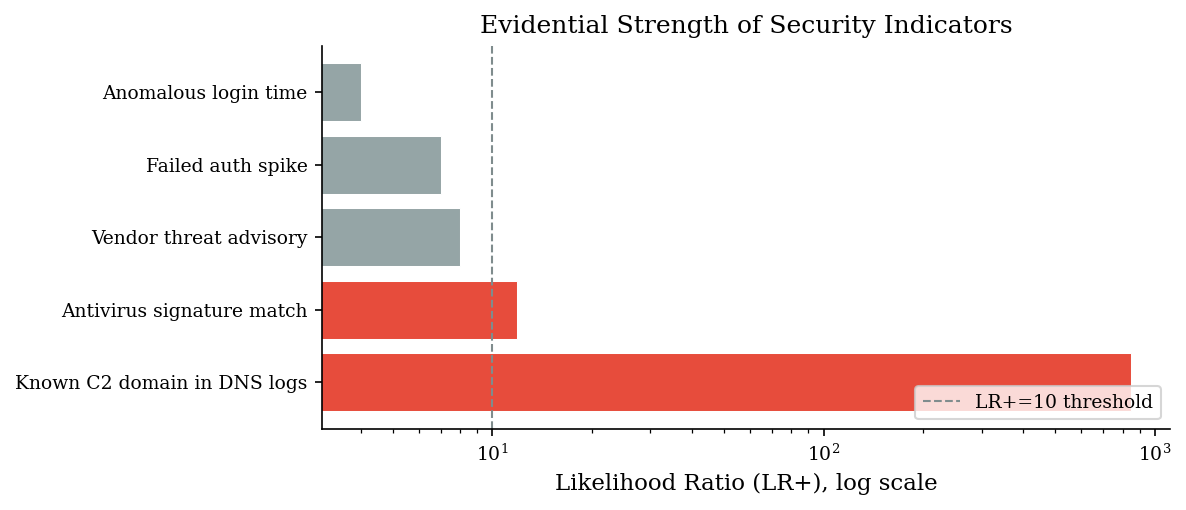
The critical insight: an indicator’s hit rate (TPR) tells you very little on its own. What matters is the ratio of the true-positive rate to the false-positive rate.
indicators = pd.DataFrame([
    {"indicator": "Known C2 domain in DNS logs", "tpr": 0.85, "fpr": 0.001},
    {"indicator": "Anomalous login time",        "tpr": 0.60, "fpr": 0.15},
    {"indicator": "Failed auth spike",            "tpr": 0.70, "fpr": 0.10},
    {"indicator": "Vendor threat advisory",       "tpr": 0.40, "fpr": 0.05},
    {"indicator": "Antivirus signature match",   "tpr": 0.95, "fpr": 0.08},
])
indicators["LR+"] = indicators["tpr"] / indicators["fpr"]
indicators["LR-"] = (1 - indicators["tpr"]) / (1 - indicators["fpr"])

indicators = indicators.sort_values("LR+", ascending=False)

print("Likelihood Ratios for Security Indicators")
print("LR+ > 10: strong evidence FOR  |  LR- < 0.1: strong evidence AGAINST")
print()
print(indicators[["indicator", "tpr", "fpr", "LR+", "LR-"]].to_string(index=False))
print()
print("LR- is the evidence from a NEGATIVE observation. C2 domain: LR- ~ 0.15, so its")
print("absence only moderately lowers suspicion; its presence (LR+ = 850) is far stronger.")
Likelihood Ratios for Security Indicators
LR+ > 10: strong evidence FOR  |  LR- < 0.1: strong evidence AGAINST

                  indicator  tpr   fpr     LR+      LR-
Known C2 domain in DNS logs 0.85 0.001 850.000 0.150150
  Antivirus signature match 0.95 0.080  11.875 0.054348
     Vendor threat advisory 0.40 0.050   8.000 0.631579
          Failed auth spike 0.70 0.100   7.000 0.333333
       Anomalous login time 0.60 0.150   4.000 0.470588

LR- is the evidence from a NEGATIVE observation. C2 domain: LR- ~ 0.15, so its
absence only moderately lowers suspicion; its presence (LR+ = 850) is far stronger.
Takeaway: do not evaluate indicators by their detection rate alone. The false positive rate is equally important.
# Log scale: the LRs span orders of magnitude
fig, ax = plt.subplots(figsize=(8, 3.5))

y_pos = range(len(indicators))
bars = ax.barh(y_pos, indicators["LR+"].values,
               color=[ACCENT if lr > 10 else LIGHT_GRAY
                      for lr in indicators["LR+"].values],
               edgecolor="white", linewidth=0.5)
ax.set_yticks(list(y_pos))
ax.set_yticklabels(indicators["indicator"].values)
ax.set_xscale("log")
ax.set_xlabel("Likelihood Ratio (LR+), log scale")
ax.set_title("Evidential Strength of Security Indicators")
ax.axvline(10, color=MED_GRAY, linestyle="--", linewidth=1, label="LR+=10 threshold")
ax.legend(loc="lower right")
plt.tight_layout()
plt.show()
4. From Prior Odds to Posterior Odds#
The odds form of Bayes’ theorem is often more intuitive for practitioners:
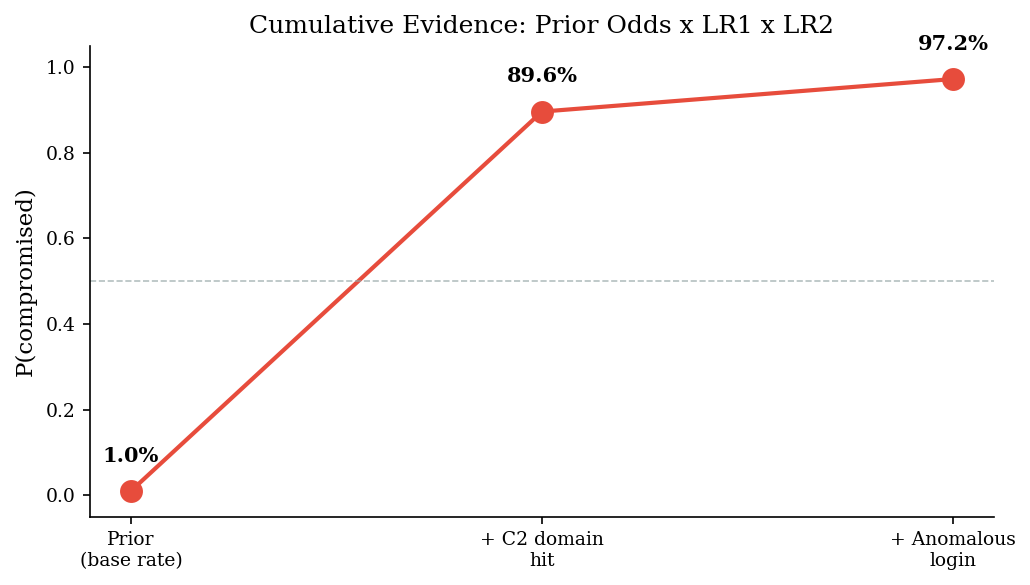
If your prior odds of compromise are 1:99 (1% probability) and you observe a C2 domain hit (LR = 850), your posterior odds are 850:99, which is approximately 8.6:1 (~90% probability). One strong indicator can shift a rare event to roughly 90% probability.
Multiple conditionally independent indicators (independent given compromise and given no compromise) multiply: posterior odds = prior odds x LR1 x LR2 x …
prior_p = 0.01
prior_odds = prior_p / (1 - prior_p)

lr_c2 = 0.85 / 0.001
posterior_odds_1 = prior_odds * lr_c2
posterior_p_1 = posterior_odds_1 / (1 + posterior_odds_1)

lr_login = 0.60 / 0.15
posterior_odds_2 = posterior_odds_1 * lr_login
posterior_p_2 = posterior_odds_2 / (1 + posterior_odds_2)

print(f"Prior:                 P(compromised) = {prior_p:.3f}  (odds {prior_odds:.4f})")
print(f"After C2 domain:       P(compromised) = {posterior_p_1:.3f}  (LR = {lr_c2:.0f})")
print(f"After anomalous login: P(compromised) = {posterior_p_2:.3f}  (LR = {lr_login:.1f})")
print()
print("Odds chain (keeping the 1% prior's 1:99 as the running denominator):")
print("    1:99  x LR 850  ->  850:99   (~90%)")
print("          x LR 4    -> 3400:99   (~97%)")
Prior:                 P(compromised) = 0.010  (odds 0.0101)
After C2 domain:       P(compromised) = 0.896  (LR = 850)
After anomalous login: P(compromised) = 0.972  (LR = 4.0)

Odds chain (keeping the 1% prior's 1:99 as the running denominator):
    1:99  x LR 850  ->  850:99   (~90%)
          x LR 4    -> 3400:99   (~97%)
stages = ["Prior\n(base rate)", "+ C2 domain\nhit", "+ Anomalous\nlogin"]
probs = [prior_p, posterior_p_1, posterior_p_2]

fig, ax = plt.subplots(figsize=(7, 4))
ax.plot(range(len(stages)), probs, "o-", color=ACCENT, markersize=10, linewidth=2)
for i, (stage, prob) in enumerate(zip(stages, probs)):
    ax.annotate(f"{prob:.1%}", (i, prob), textcoords="offset points",
                xytext=(0, 14), ha="center", fontsize=10, fontweight="bold")

ax.set_xticks(range(len(stages)))
ax.set_xticklabels(stages)
ax.set_ylabel("P(compromised)")
ax.set_title("Cumulative Evidence: Prior Odds x LR1 x LR2")
ax.set_ylim(-0.05, 1.05)
ax.axhline(0.5, color=LIGHT_GRAY, linestyle="--", linewidth=0.8, alpha=0.7)
plt.tight_layout()
plt.show()
5. Calibration — Are Your Probability Estimates Any Good?#
Bayesian updating only works if your inputs are calibrated. If you say “70% chance of exploitation” for 100 vulnerabilities, roughly 70 should be exploited. Most untrained analysts are overconfident — their 90% predictions come true noticeably less than 90% of the time (Lichtenstein, Fischhoff & Phillips 1982; Hubbard 2014).
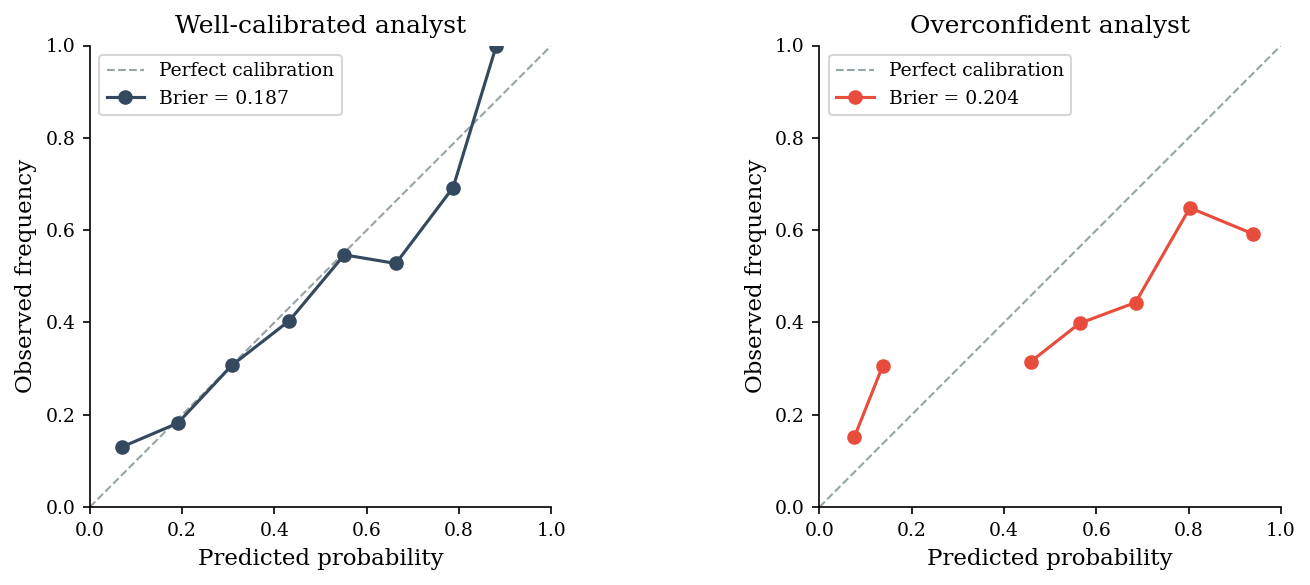
We simulate two analysts making 2,000 exploitation predictions each (even so, the overconfident analyst leaves one calibration bin empty, and the highest bins are thin):
Well-calibrated: predictions track reality with small random noise
Overconfident: inflates high probabilities toward 1, deflates low ones toward 0
n_preds = 2000
true_probs = rng.beta(2, 5, n_preds)  # ground truth: skewed toward low probs
outcomes = rng.binomial(1, true_probs)

calibrated_forecasts = true_probs + rng.normal(0, 0.05, n_preds)
calibrated_forecasts = np.clip(calibrated_forecasts, 0.01, 0.99)

# Overconfident analyst: a synthetic caricature that pushes forecasts away from the
# base rate toward both extremes.
overconfident_forecasts = np.where(
    true_probs > 0.3,
    np.clip(true_probs * 1.4, 0, 0.99),
    np.clip(true_probs * 0.5, 0.01, 1)
)

bs_cal = brier_score(calibrated_forecasts, outcomes)
bs_over = brier_score(overconfident_forecasts, outcomes)

fig, axes = plt.subplots(1, 2, figsize=(10, 4))

for ax, forecasts, label, bs, color in [
    (axes[0], calibrated_forecasts, "Well-calibrated analyst", bs_cal, DARK_BG),
    (axes[1], overconfident_forecasts, "Overconfident analyst", bs_over, ACCENT),
]:
    bins_c, observed = calibration_curve(forecasts, outcomes, bins=8)
    ax.plot([0, 1], [0, 1], "--", color=LIGHT_GRAY, linewidth=1,
            label="Perfect calibration")
    ax.plot(bins_c, observed, "o-", color=color, markersize=6,
            label=f"Brier = {bs:.3f}")
    ax.set_xlabel("Predicted probability")
    ax.set_ylabel("Observed frequency")
    ax.set_title(label)
    ax.set_xlim(0, 1)
    ax.set_ylim(0, 1)
    ax.set_aspect("equal")
    ax.legend(loc="upper left")

plt.tight_layout()
plt.show()

print(f"Well-calibrated Brier score: {bs_cal:.3f}")
print(f"Overconfident Brier score:   {bs_over:.3f}")
print("Lower = more accurate overall (calibration + resolution); 0 is perfect.")
Well-calibrated Brier score: 0.187
Overconfident Brier score:   0.204
Lower = more accurate overall (calibration + resolution); 0 is perfect.
The well-calibrated analyst’s dots hug the diagonal: when they say 30%, it happens about 30% of the time. The overconfident analyst’s curve deviates systematically, which contributes to the higher Brier score (Brier measures overall accuracy: calibration plus resolution).
Why this matters for Bayesian updating: if your prior probabilities are miscalibrated, every subsequent update inherits that bias. Calibration training (predict, observe, score, adjust) is a high-leverage improvement.
6. Pitfalls and Practical Guidance#
Base rate neglect is the #1 Bayesian failure in security. A 95%-accurate threat detector applied to a 0.1% base rate produces 98% false positives. Make that concrete with the positive predictive value:
So only ~1.9% of alerts are real. Always start with the prior.
Likelihood ratios, not hit rates, determine evidence strength. An indicator with 95% TPR but 8% FPR is weaker evidence when it fires than one with 85% TPR and 0.1% FPR.
Sequential updating requires conditionally independent sources. If two threat intel feeds share the same upstream source, double-updating inflates confidence. Know your intelligence supply chain.
Overconfidence compounds. If every estimate in your chain is 20% too confident, the final posterior can be wildly wrong. Calibrate your inputs before trusting your outputs.
The base rate is not optional. “But we don’t know the base rate” is not an excuse to skip it. An uncertain prior (wide Beta) is still better than an implicit prior of 50%, which is what you get when you ignore base rates entirely.
Next: Part 1.3 covers Value of Information — when a pentest, threat assessment, or more data collection is actually worth paying for.